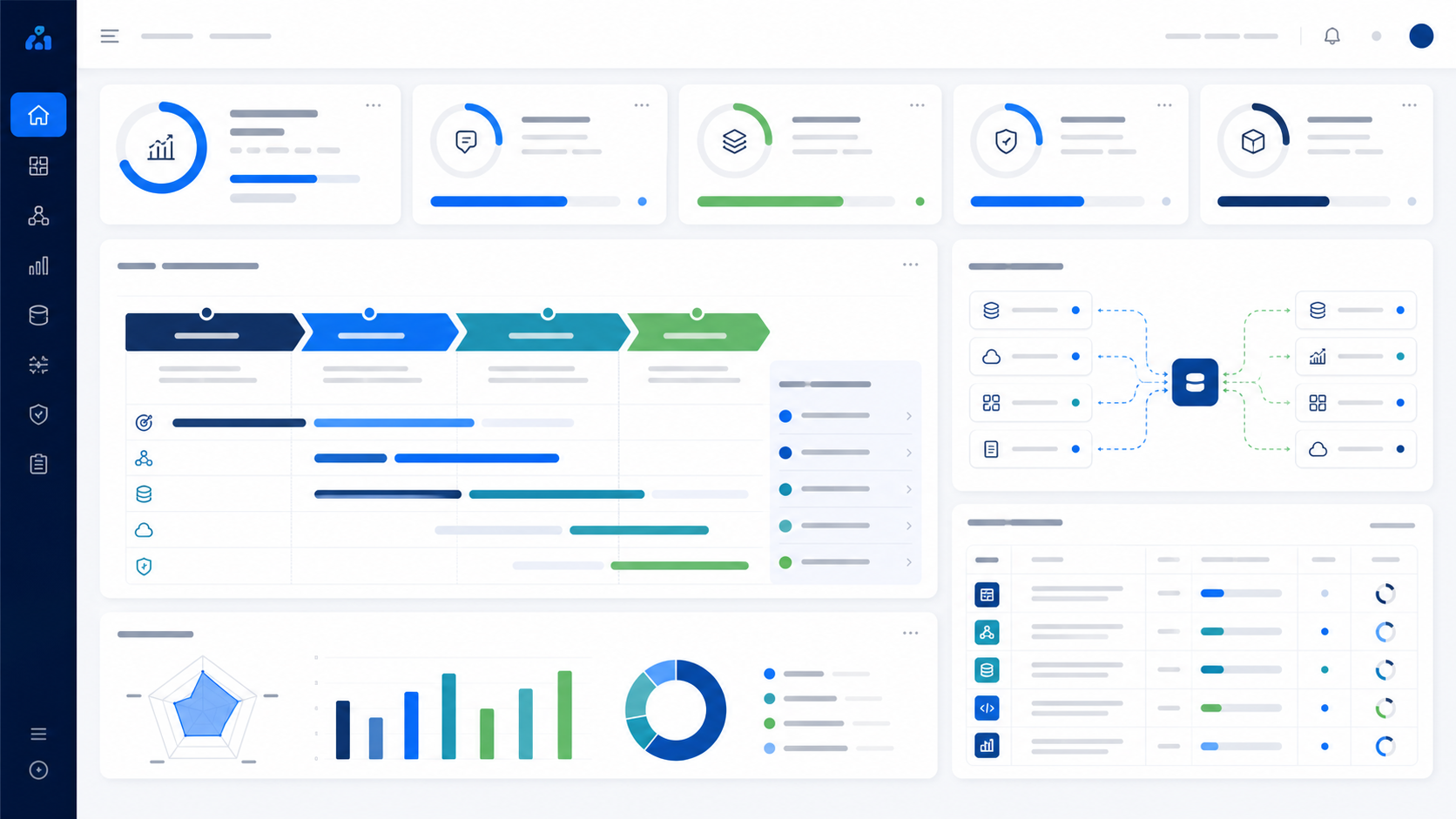
Manufacturing KPI reporting becomes valuable only when it helps leadership make faster and better decisions. Many factories collect large amounts of data but still struggle to answer basic questions quickly: where is output falling, which line is underperforming, where is downtime increasing and which product family is damaging delivery performance? That gap exists because data collection alone is not the same as reporting design. The right reporting model for manufacturing KPIs should connect production, quality, inventory, capacity and delivery performance into one usable decision layer.
Search demand around manufacturing KPI dashboards, production reporting, OEE monitoring, capacity utilization, scrap rates and on-time delivery is strong because factories need visibility, not only records. A manufacturing business can have an ERP system, MRP structure and production planning process in place, but if reporting is weak, management still reacts too late. The purpose of a KPI model is to convert operational complexity into clear signals. Those signals should make losses visible, highlight bottlenecks and guide corrective action before the problem grows.
Which manufacturing KPIs matter most?
The answer depends on business model, but several KPI groups appear consistently across manufacturing environments. Output and throughput indicators show whether production targets are being met. Capacity and utilization metrics show whether resources are overloaded or underused. Quality indicators such as defect rate, scrap rate and rework level reveal whether growth is happening efficiently. Inventory and material flow indicators highlight stock risk, material shortages and planning weakness. Delivery KPIs show how reliably the operation turns production into customer value.
What matters is not only listing these KPIs, but arranging them in a useful hierarchy. Leadership does not need the same level of detail as supervisors. Executives need a high-level dashboard showing trend direction, financial impact and risk areas. Production managers need deeper views that explain root causes. If the reporting model mixes all layers together, the dashboard becomes crowded and decisions slow down.
Why reporting should be connected to ERP, MRP and shop-floor data
Manufacturing KPIs become far more reliable when they are fed from the same operational systems that run planning and execution. ERP contributes financial and order context, MRP contributes material logic, production systems contribute execution detail and warehouse systems contribute stock accuracy. If KPI dashboards rely on disconnected spreadsheets or manually assembled reports, decision speed drops and trust in the numbers falls. In contrast, integrated reporting gives management one consistent view of production performance.
This is also why many searches around manufacturing reporting focus on real-time dashboards. The value of reporting is not only in historical review. It is in operational timing. A late report may explain yesterday’s problem, but a strong dashboard helps prevent tomorrow’s one.
What should a strong manufacturing KPI reporting model include?
- Executive-level summary metrics tied to output, delivery, quality and cost
- Line-level and shift-level drilldowns for root-cause visibility
- Connections between ERP, MRP, inventory, quality and production data
- Trend analysis, threshold alerts and exception visibility
- Clear ownership for each KPI so reporting leads to action
In short, the right reporting model for manufacturing KPIs is not a reporting style choice. It is part of operational control. When the KPI layer is designed well, leadership sees problems earlier, teams align faster and production goals become easier to manage. For manufacturing companies investing in ERP, MRP and digital operations, reporting should never be an afterthought. It is the layer that turns data into decisions.
